


Epstein Files, La Hougue Trust Records, and the Unresolved Questions re Mr Dick's old business partner's brutal murder.

The Murder of Mr James William Durrant — And the Investigation That Began 31 Years Later
Mr James William Durrant was killed on 26 October 1988 after returning to his home at 12 Cranes Park Avenue, Surbiton. Earlier that evening, he had attended a meeting at the Grand Hall of Freemasons. Before leaving for that meeting, he had been babysitting one of his youngest grandsons, Jordan Durante.
For more than three decades, the circumstances surrounding Mr Durrant’s murder remained unresolved.
The Timing of a Divorce Filing – October 26th 1988
On October 26th 1988 — the very day Mr James William Durrant was killed — a significant and often overlooked event occurred in the United States.
On that same date, the wife of Mr Durrant’s former business partner filed for divorce.
This coincidence in timing raises important questions.
It has long been documented that a late-night meeting took place at Mr Durrant’s home on the evening of his death. The reason for that meeting has never been satisfactorily clarified in public records.
The filing of divorce proceedings in the United States on the exact same date introduces a potential contextual factor that merits closer examination. Divorce actions involving high-value individuals can sometimes intersect with financial restructurings, asset declarations, trust arrangements, or partnership liabilities.
Was the late-night meeting connected in any way to financial matters that may have been affected by the divorce filing?
Was there urgency created by proceedings in another jurisdiction?
Or is the timing merely coincidence?
These are questions that have never been fully explored in the original investigation.
When reviewing historical cases involving complex financial structures, offshore trusts, and business partnerships, precise timelines matter. The events of October 26th 1988 — both in the United Kingdom and the United States — form part of that timeline.
Further examination of the surrounding documentation may help clarify whether the overlap in dates is incidental or significant.


In December 2019 — 31 years later — Jordan Durante began reviewing the events surrounding his grandfather’s murder. His research extended beyond the homicide investigation itself and into a number of family trust structures that Mr Durrant had established during his lifetime.
What followed was years of document review, cross-border inquiries, and collaboration with individuals who possessed related records and institutional knowledge. During this process, Jordan formed an unexpected connection with individuals linked to those who had been associated with his grandfather’s affairs at the time of his murder.
The developments that emerged from that collaboration form a significant part of the broader investigation and are summarised below.
December 2020: A Turning Point
In December 2020, the Durante family dismissed their first Isle of Man advocate. The family’s position was that the advocate had failed to act in their best interests and had prioritised protecting the Isle of Man’s international financial reputation. In their view, a full public examination of the Durrant case could have raised broader questions about regulatory oversight within the offshore trust industry.
Shortly before Christmas 2020, Jordan Durante was conducting late-night research into historical trust structures connected to his grandfather’s estate. During this process, he came across a media article concerning the same family trust service provider that had, at that stage, not made distributions to the family ever.
Recognising the potential relevance, Jordan contacted the journalist who had written the article and requested an introduction to members of the Dick family.
Initial contact was subsequently established in January 2021.


La Hougue shown in the Epstein files below-


January 2021: Collaboration Begins
In early January 2021, Jordan Durante held a Zoom call with Darrin Dick-Stock and his wife, Tanya. During that discussion, they exchanged perspectives on offshore financial centres, regulatory standards, and their respective experiences with trust service providers.
All parties expressed a shared interest in transparency and accountability within the offshore trust industry. It was agreed that they would collaborate, share documentation, and compare historical records relevant to their separate cases.
In the early stages, Darrin and Tanya were supportive and forthcoming in their communications with Jordan. They provided background context and insight into how offshore trust structures can operate in practice, which Jordan found informative while developing his own understanding of the industry.
At the time, Jordan was not aware of the full extent of the archival material Darrin and Tanya possessed. They had previously recovered a substantial collection of historical documents — reportedly stored in boxes at St John’s Manor — which they had reviewed over years prior to their meeting with Jordan.
The significance of those records would become clearer as the collaboration progressed.
The Introduction of the “St John’s Manor” Files
After several months of exchanging documents — the majority of which originated from the Durante family’s records — Darrin and Tanya suggested that Jordan review materials they described as being from the “St John’s Manor” boxes.
They indicated that these archived files contained historical trust documentation and examples of how certain trust deeds had been drafted, amended, or reconstructed over time.
During these discussions, Darrin and Tanya expressed the view that, within parts of the offshore trust industry, documentation could be created or modified in ways that raised serious concerns about authenticity and governance standards. They suggested that the St John’s Manor materials illustrated how trust instruments might be produced or altered when required.
Jordan regarded these representations as significant, particularly in light of his ongoing review of historical deeds connected to his grandfather’s estate.
The relevance of those materials would later form part of the broader questions he continued to examine.
The First Document Referencing La Hougue
The first document shared with Jordan from the “St John’s Manor” files was, according to Darrin and Tanya, an example of the type of material they had been describing.
Within that file was a reference to a company called La Hougue. The document contained language suggesting that trust deeds and supporting paperwork could be recreated or constructed retrospectively, including a statement referring to matching “the age of the ink and paper.”
At that stage, Jordan had no prior awareness of La Hougue or of Mr Richard Wigley. The names had not appeared in any of the family records he had reviewed, nor had they featured in his earlier research into the trust structures connected to his grandfather’s estate.
The introduction of those names marked the beginning of a new and distinct line of inquiry. From that point forward, Jordan began independently cross-referencing the references against publicly available records, archived filings, and third-party documentation in order to verify what, if any, connection existed.
It was the moment when the investigation widened beyond family-held documents and into a broader examination of offshore trust networks and publicly released materials.
Background Context for Readers
For clarity, it is important to explain why certain names became relevant to Jordan’s investigation.
Publicly available records show that Mr Richard Wigley previously worked at Barclaytrust International in Jersey. During that period, Mr James William Durrant was a client of Barclaytrust in Jersey. This establishes that the two men operated within the same professional environment at the time. Mr Richard Wigley and Mr Durrant clearly knew each other.
Corporate and property records also indicate that Mr Wigley has had associations with companies and properties connected to the Wimbledon area — geographically close to Surbiton, where Mr Durrant lived and where he was murdered.
In addition, trust documentation reviewed by Jordan refers to a transaction in 1984 in which funds amounting to 74 million US dollars were transferred into what are described as the Dick Family Trusts 1, 2 and 3.
The records state that Mr Wigley was connected to that transaction as the settlor of the Dick family trusts 1,2 and 3 and that trustee appointments were made at that time, including the appointment of the Durante family impostor trustee[mentioned in the newspaper article above] later disputed by the Durante family, alongside Barclaytrust International as co-trustee of the Dick family trusts.
Who Was the True Settlor of the Millions?
In court proceedings, Mr Wigley stated that he was not the true settlor of the millions in question. He indicated that he signed documents as instructed and suggested that he was acting on the direction of Mr John William Dick.
This statement is significant.
If Mr Wigley was not the true source of the funds, and merely executed documentation at the instruction of another, then a fundamental question arises:
Who was the real settlor of these millions?
In trust law, the identity of the settlor is not a minor technical detail. The settlor is the person who provides the funds and establishes the trust structure. Their identity determines the legal origin of the funds, the tax treatment, and the legitimacy of the entire arrangement.
If documentation was signed by an individual who later states he was not the genuine source of the funds, then clarity is required on several key points:
Who provided the original capital?
Who exercised control over the structure?
Who benefited from the arrangement?
Why would a signatory state in open court that he was acting on instruction?
These questions are not speculative — they go to the heart of beneficial ownership, transparency, and compliance.
If Mr Wigley was not the true settlor, and if he signed documents at the direction of Mr John William Dick, then the logical next step is to identify the person or entity that genuinely originated the funds.
The integrity of the trust structure depends on that answer.
Until the identity of the true settlor is clearly established, the issue remains unresolved.

.


International Contact and Jurisdictional Questions
Mr Wigley has been traced to Panama during the course of Jordan’s independent investigation.
Jordan states that contact was made with authorities in Panama, including Interpol channels, and that there was an indication of willingness to review or assess the information provided and act on it.
However, Jordan further states that subsequent developments within the United Kingdom — specifically involving the Metropolitan Police — resulted in no further visible action being taken.
This sequence of events raises procedural questions:
What formal requests, if any, were submitted?
Was there an official referral between jurisdictions?
On what basis was further action paused or discontinued?
Were evidential thresholds considered insufficient, or was the matter deemed outside operational scope?
At present, there has been no publicly available explanation clarifying the full procedural position between UK authorities and Panama, but Panama were willing to act when they saw the witness statement below but needed to be instructed by UK channels via the NCA.[whole story on this].
The documentation relating to these communications is said to be available to accredited international media or relevant agencies capable of reviewing cross-border financial and legal matters.
Transparency regarding jurisdictional decisions is often critical in cases involving offshore financial structures and multiple legal territories.

A Moment of Realisation
When Jordan received the file, he happened to be in Spain. While reviewing the documents that evening, one particular address immediately caught his attention.
He telephoned Darrin and Tanya and asked a direct question: “Who owes whom 100 million dollars?” His reaction was prompted by an address listed within their material — Lingfield Avenue, Kingston upon Thames.
Jordan pointed out that Lingfield Avenue is located extremely close to Cranes Park Avenue in Surbiton, the road where his grandfather had lived and where he was killed in 1988.
According to Jordan’s recollection of the call, the significance of that geographical proximity had not previously been discussed in relation to his own family’s history. During the conversation, emotions ran high. Tanya expressed distress and apologised, stating that, in her view, the implications now appeared obvious. Darrin responded by emphasising that the address was not in the exact same town centre, but was only the next block.
For Jordan, however, the relevance lay in the proximity itself. The appearance of a substantial financial figure alongside an address located only streets away from the site of his grandfather’s murder was, in his view, too significant to ignore.
It was another moment where the investigation moved beyond abstract trust structures and into tangible, real-world geography as shown below in google maps. The fake repayment and the murder scene shown below.

The 74 Million Dollar Loan Notes
The loan notes contained within the file total 74 million US dollars.
At the time these documents were first reviewed, Jordan had only recently been provided with the file and had not yet been given access to the wider underlying documentation or supporting records.
One detail that immediately stood out was the stated interest rate.
The loan notes are recorded at 8 percent — a rate consistent with other historical deeds associated with Mr Durrant’s financial arrangements. That consistency raises legitimate questions regarding drafting patterns and structural similarities.
It is also stated within the documentation that the settlor is English, and that the deed is governed by UK law.
These points are important for several reasons:
The governing law determines legal interpretation and enforcement.
The nationality or domicile of the settlor has tax and regulatory implications.
The interest rate alignment may suggest either coincidence or structural continuity.
At this stage, the existence of the 74 million dollar loan notes, their 8 percent rate, and the reference to an English settlor governed by UK law form part of a wider evidential picture.
Whether these similarities are incidental or indicative of a deeper connection is a matter that requires further scrutiny.
Extracts of the Loan Documentation
The extracts of the loan notes shown below are reproduced in partial form.
Certain sections have been redacted for responsible reasons. In particular, identifying details relating to a female accountant have been withheld.
When approached, the accountant is said to have cooperated appropriately and provided a signed witness statement. That statement will be referenced and presented separately.
The decision to publish only partial extracts reflects two principles:
Protection of individuals who have acted responsibly when asked to clarify documentation.
Preservation of the integrity of ongoing review and potential legal processes.
The redactions do not alter the substantive features under examination — namely the structure of the loan notes, the stated interest rate, and the references to governing law and settlor description.
Further contextual material will be set out in the following section.


Signatories and Correspondence Regarding Repayment
The loan notes in question were signed by Alan Fishman.
The documentation provided within the file shows the execution of the loan instruments, and readers are able to review the visible signature within the extracts reproduced on this page.
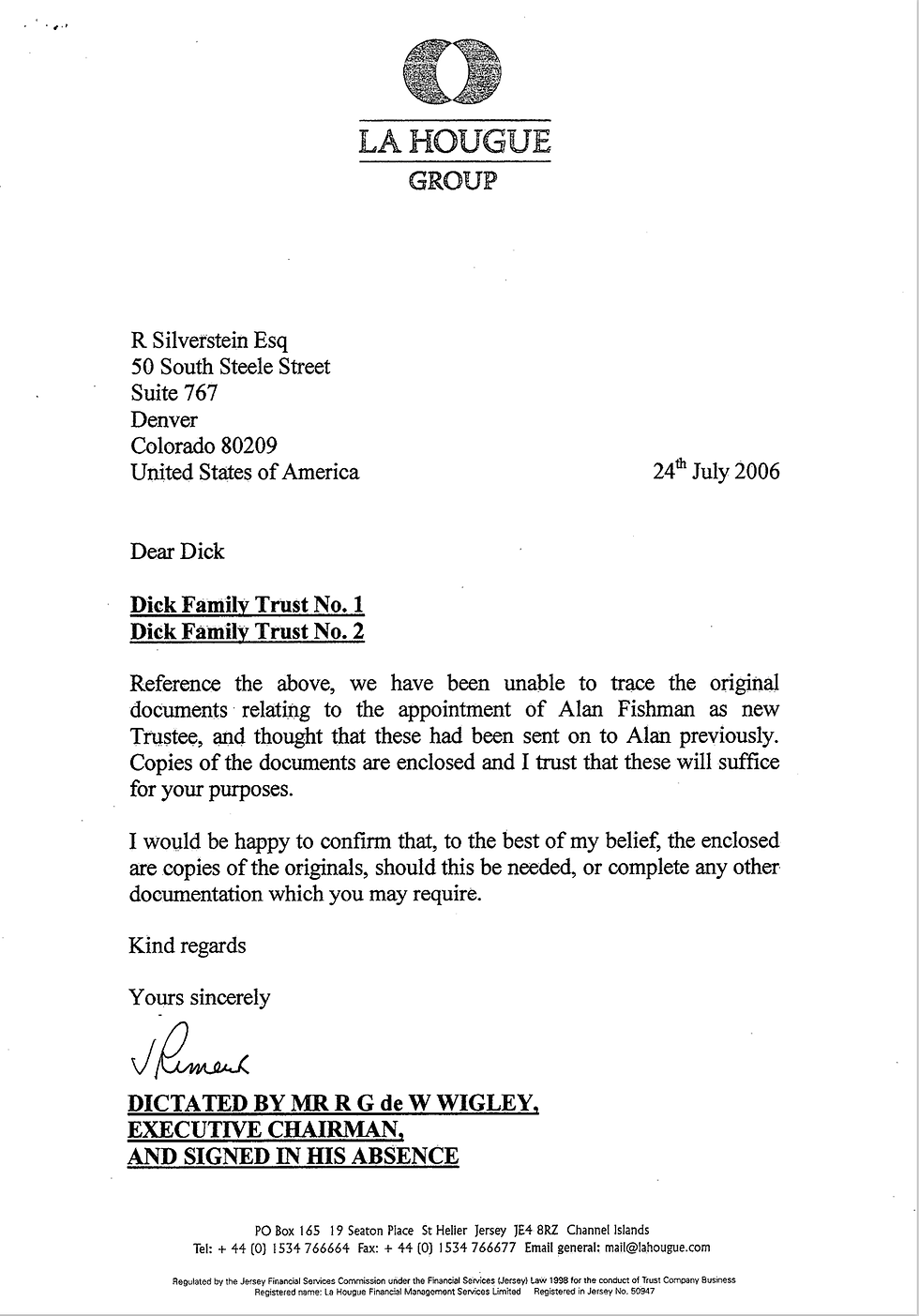
Accompanying correspondence from La Hougue is also shown below. These letters refer to loan commitment agreements and set out references to repayment obligations, including an indication that the millions were to be repaid by December 2002.
The existence of:
Signed loan notes,
Written references to formal loan commitments, and
A defined repayment time frame
forms part of the broader evidential record under examination.
At this stage, the documentation demonstrates that structured repayment terms were contemplated and recorded in writing. Whether those commitments were fulfilled, restructured, waived, or otherwise varied is a matter that requires review of the full accounting and transactional history.
The material presented here is limited to what is contained within the file provided.
Further contextual documentation will assist in clarifying the full financial position.


Statement Attributed in Published Article
A published article referring to Alan Fishman includes comments in which responsibility is attributed to Mr John William Dick, who is described in that reporting as the “mastermind.”
It is important to be precise:.

Internal Correspondence Regarding the Status of the Loans
The internal email reproduced below is attributed to Jenny Rimeur, who is understood to have previously worked at Barclaytrust before later joining La Hougue.
It is noted that Ms Rimeur is said to have known Mr Durrant from her earlier professional role at Barclaytrust.
Within the email, the loans in question are described as having been cancelled and paid in full.
This wording is significant.
If loan notes totalling 74 million US dollars were:
Originally structured with formal commitment agreements,
Assigned an 8 percent interest rate, and
Key questions naturally arise:
What accounting entries reflect the cancellation?
What evidence supports the claim of full repayment?
On whose authority were the loans cancelled?
The terminology used in internal correspondence carries weight. “Cancelled” and “paid in full” are not casual phrases in structured financial arrangements involving millions of dollars.
The extracts below are presented for transparency and examination.
Further documentation will be required to determine whether the recorded cancellation aligns with the underlying financial reality.

The historical loans are discussed below.
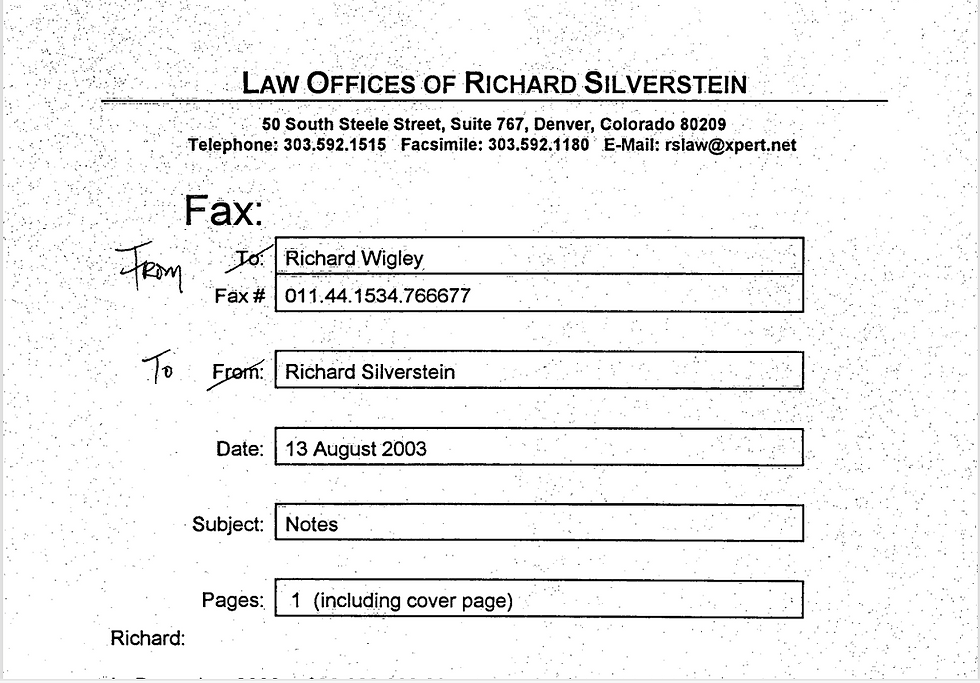

Questions Regarding Execution of the Original Trust Documents
The email reproduced below indicates that internal questions arose as to whether the original Dick family trust documents were ever formally executed.
It is stated within the correspondence that only unsigned versions of certain trust documents were available at that time.
This point is significant in trust law.
For a trust deed to take legal effect, it must normally be properly executed in accordance with the governing law. An unsigned draft does not ordinarily carry the same legal status as a completed, signed instrument.
The reader should also note the following contextual issue:
An unsigned trust deed is said to have been produced after Mr Durrant’s murder. That document, as presented, did not contain:
Mr Durrant’s name,
Reference to his family, or
His signature.
These features are relevant because identity, intention, and execution are fundamental components in the creation of a valid trust instrument.
The sequence therefore raises important procedural questions:
Were original executed versions ever completed and retained?
If so, where are they now?
If not, on what basis were subsequent trust arrangements relied upon?
What evidential weight should be attached to an unsigned document produced after the death of an interested party?
The email below forms part of the documentary record and illustrates that concerns regarding execution were raised internally.
Whether the unsigned document reflects a draft, a replacement, or a document intended for some other purpose requires careful examination of the full trust history and governing legal framework.


Deed Identifying the Settlor and Trustee Appointment
The deed reproduced below identifies Mr Wigley as the settlor of certain trusts associated with the Dick family.
It also records the appointment of a trustee described within the documentation as acting in relation to both the Dick family structures and the Durante family arrangements.
Fund Manager and Trustee Connections
It is noted that during his lifetime, Mr Robert Maxwell used the same fund management company as Mr Durrant.
That same fund management company is recorded as having been appointed trustee by Mr Wigley within the deed.
Mr Wigley is not the true settlor of these millions and admits that in court cases and blames Mr Dick.


Return to the United Kingdom and Review of the Loan Documentation
Following extended review of the trust documentation, Jordan states that he was able to secure a payment under the terms of the unsigned deed that had been produced after his grandfather’s death.
He maintains that this followed detailed correspondence with the acting trustee, during which he set out historical research into the trust structures and associated professional relationships spanning several decades which involved drug cartels and Mr Maxwell's murder.
That payment enabled Jordan and his elderly parents to relocate from Spain back to the United Kingdom.
Visit to the Address Referenced in the Loan Notes
After returning to the UK, Jordan attended, with a friend, the address listed in the loan note documentation.
Through enquiries at that address, he located a lady accountant who is understood to have acted as accountant to Mr John William Dick.
Jordan states that he provided her with copies of the loan notes and related documents.
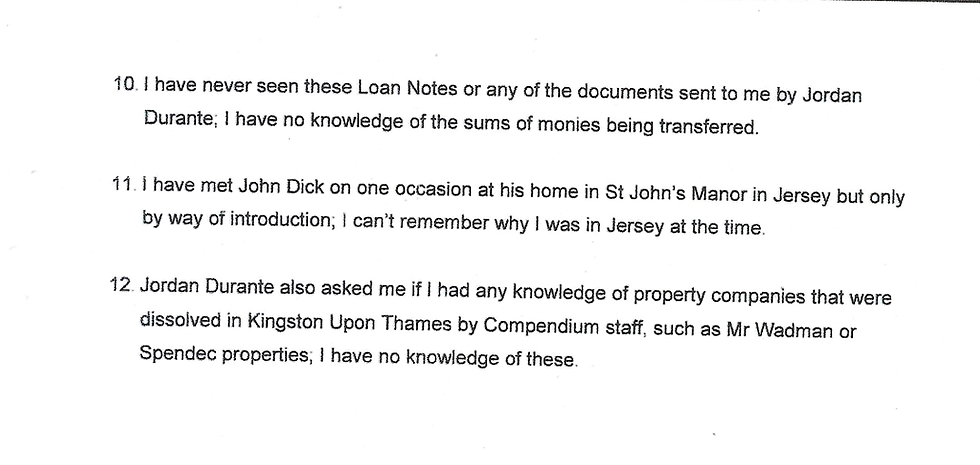
Following review, she agreed to sign a witness statement in the presence of a former police officer.
According to Jordan, the witness statement records that the millions referenced in the loan notes were not repaid to her accountancy firm at the address specified in the documentation.
Evidential Position
The material referenced above consists of:
Loan notes totalling 74 million US dollars
Correspondence referring to repayment commitments
An internal email stating the loans were “cancelled and paid in full”
A witness statement addressing whether repayment was received
The documentation and witness statement form part of the evidential file now compiled.
The first witness statement is partially redacted but below this is relevant parts for the reader.


Identification of Previously Unrecorded Business Associates
During the course of his independent review, Jordan identified seven individuals who, according to the documentary material he obtained, had been involved in business arrangements with his grandfather.
Jordan states that these individuals were not referenced in the original murder investigation files available to the family.
The existence of these names was subsequently reflected in correspondence from New Scotland Yard addressed to Sir Edward Davey MP, acknowledging receipt of information provided.
Among the individuals identified in Jordan’s review was Mr John William Dick.
Significance of the Identification
The relevance of this development lies in three areas:
The completeness of the original investigative scope
The mapping of professional and financial relationships
The potential intersection between business arrangements and motive
Where new names emerge decades after an investigation has concluded, the question is not assumption — but completeness.
Were all relevant commercial relationships fully examined at the time?
The correspondence from New Scotland Yard confirms that the additional material was received and reviewed. What further investigative steps, if any, followed is a matter of record within official channels.
The identification of Mr John Dick as one of the seven individuals forms part of the evidential matrix now compiled.
The email below states that the seven individuals identified were involved in the family trust structures in the period following Mr Durrant’s death.
This raises an important question: in what capacity did Mr John Dick play a role?
Jordan notes that Mr Dick does not appear directly in certain publicly available paperwork, and that legal representatives have declined to discuss him in detail.
Jordan maintains that he has compiled material addressing this issue and states that he is prepared to explain the basis of his position in full, if and when required.


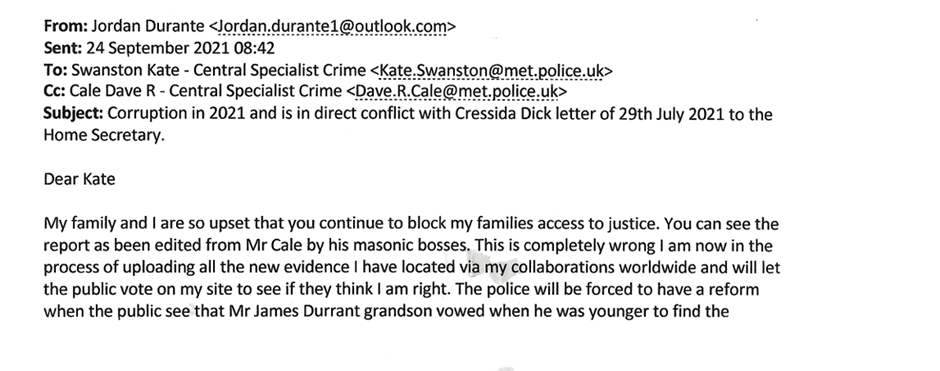
2021 Email to Police Identifying Seven Business Associates
In 2021, Jordan sent a detailed email to the Metropolitan Police setting out the names of seven individuals who, according to the documentary material he had obtained, were involved in business arrangements with his grandfather.

The above email is a crucial piece of evidence, as it identifies seven individuals in business with Mr. Durrant that Jordan uncovered. As will be shown, these seven individuals played significant roles in the family trusts in the aftermath of Mr. Durrant’s murder and are among those who ultimately benefited from this financially motivated crime. Of particular importance is the name of Mr. John Dick. His involvement raises serious questions: how did he come to play a role in the trusts after Mr. Durrant’s death when he is never mentioned in any official documents or by any lawyer? Which trust was he connected to—and was it one of the stolen trusts that Jordan has since located?
The email exchanges below between Jordan and the Metropolitan Police are reproduced for context.
Jordan states that over a period of time the case was closed on multiple occasions. He further states that he was not informed that the identification of seven individuals connected to his grandfather’s business affairs had been incorporated into any formal review. Instead, he was advised that his material was not considered relevant.
Jordan did not accept that position and continued to submit documentation and correspondence.
As of the time of writing, he understands that the case is open again and subject to ongoing review by higher levels.


The post office scandal links-

The offshore data leak referenced above, originating from Mossack Fonseca in Panama, includes reference to a company named Coller International registered at Seaton House in Jersey.
The screenshots reproduced below also show the Master Trust Bank of Japan listed as trustee of the Fujitsu Pension.
These references are presented for contextual purposes as part of the wider documentary review. The inclusion of a company name in an offshore data leak does not in itself establish wrongdoing, but it may assist in mapping corporate structures, trustee appointments, and professional relationships across jurisdictions.
Similarly, the identification of a trustee within pension documentation reflects a formal fiduciary role within that specific structure.
The material is shown to illustrate the broader network of entities and institutional connections identified during the course of the review.

Fujitsu is a Isle of Man company for the public's knowledge.
Summary of Letter Dated 22 February 1991
The letter is from Jaques & Lewis, Solicitors, based at 18 St. Georges Street, Douglas, Isle of Man. It is dated 22 February 1991 and marked as received.
Seeks explanation as to why the client considers himself the established beneficiary of the Jersey trusts.
Importantly, the letter states:
“My understanding is that the beneficiaries of these trusts are various charitable/masonic organisations as matters currently stand.”
This indicates that, at the time of writing, the position being stated was that the beneficiaries of the Jersey trusts were charitable or Masonic organisations.
The other Jersey trusts have been located by Jordan and do not name the Freemasons as the beneficiaries so the public know you can not trust these so called trustee's and trust companies anymore. .
Address Reference at the Bottom of the Letter
At the bottom of the letterhead, multiple office addresses are listed. One of these is:
Suite No. 2, Seaton House, 17–19 Seaton Place, St. Helier, Jersey JE2 3QL, Channel Islands
This confirms the Jersey office location as Seaton House.

Hundreds of letters and internal documents originating from La Hougue have been compiled and preserved.
Jordan states that this material is organised and ready for review. He intends to make the full documentary record available to an appropriate regulatory body, investigative agency, or accredited press organisation upon formal approach.
The documents are retained in order to ensure that any future examination can be conducted in a structured and evidential manner.
The letter reproduced below from La Hougue confirms its address as Seaton House in Jersey.
It is also noted that Mr Smalley is recorded as using the same Seaton House address in the documentation shown.
The appearance of overlapping addresses between entities and individuals operating across Jersey and the Isle of Man forms part of the wider documentary pattern under review.
Jordan states that, over time, he has gathered extensive material suggesting coordinated professional activity between service providers operating in these jurisdictions. He maintains that this material supports his position and is retained in full.
He further states that the documentation will be made available to an appropriate regulatory authority, investigative body, or accredited press organisation upon formal request.
The material is presented here for contextual reference as part of the broader reconstruction of historical corporate and trust relationships.
Trustee Changes and the Question of a Deed of Retirement and Appointment (DORA)
Following the death of Robert Maxwell, Mr John William Dick is recorded as becoming trustee of the Maxwell family trust structures.
Prior to that appointment, Compendium is understood to have acted in a trustee capacity.
In circumstances where a trustee retires and another is appointed, it is standard practice for a Deed of Retirement and Appointment (DORA) to be executed. Such a document records:
The lawful retirement of the outgoing trustee,
The appointment of the incoming trustee, and
The transfer of trust property and responsibilities.
The question therefore arises:
Is there a properly executed DORA demonstrating that Compendium lawfully retired and that Mr Dick was validly appointed as successor trustee?
Comparison with the 74 Million Dollar Trust Documentation
A parallel issue arises in relation to the 74 million dollar trust documentation.
In that structure, Mr Wigley is recorded as settlor and subsequently appoints professional trustees including Barclaytrust and Compendium.
Where trustees are appointed or replaced, the validity of those transitions depends on:
Proper execution of appointment instruments,
Compliance with the governing law of the trust, and
Accurate recording in corporate and trust records.
Accordingly, all retirements and appointments of trustees within these interconnected structures require review to ensure that:
Authority was properly exercised,
The chain of title to trust assets was preserved, and
No documentary gaps exist.
Trust law depends heavily on procedural precision. Where multiple trustees, jurisdictions, and overlapping professional relationships are involved, the documentary trail must be complete and verifiable.
Shared Fund Management and Directorship Links
During their lifetimes, both Robert Maxwell and Mr Durrant are recorded as having used the same trust service provider in a fund management capacity.
The documentation also shows that the two structures shared a common company director: Neil E Wakeling.
Mr Wakeling is recorded as:
A director of companies associated with Mr Durrant in Jersey, and
A director of Bishopsgate Investments, a company associated with Mr Maxwell.
The existence of overlapping directorships and professional service providers forms part of the reconstructed corporate network.
Shared directors or fund managers do not in themselves establish coordination or impropriety. However, such overlaps can be relevant when mapping historical business relationships and understanding how trust and corporate structures were administered.
The documentation below illustrates these shared appointments.

Following the death of Robert Maxwell, companies within his business group — including Bishopsgate Investments — were reported to have substantial outstanding liabilities internationally.
Media reporting at the time indicated that significant sums were claimed by various parties. Among those reported claims were amounts said to involve the Bulgarian government, with figures in the region of 200 million US dollars referenced in public commentary.
The recovery of funds linked to the Maxwell corporate structures became the subject of complex cross-border proceedings. Various factors were discussed publicly in relation to those recovery efforts, including jurisdictional issues and offshore corporate frameworks.
The YouTube clip referenced below summarises aspects of that reporting and reflects how the matter has been described in media commentary.
As with all historical financial cases, readers are encouraged to distinguish between:
Reported claims,
Court findings, and
Commentary or opinion expressed in media sources.
The material is referenced here for contextual background concerning the financial position of Maxwell-associated companies following his death.

The screenshot below shows Bishopsgate Investments within the relevant corporate records.
Upon further navigation from the entry shown, the name Mark Thatcher appears in the associated corporate information.

The material below shows the name Mark Thatcher appearing within corporate registry records. The pathway to that listing is visible through publicly accessible company information connected to Bishopsgate Investments.
The proximity of corporate records — where one name appears within a short registry navigation distance from entities associated with the trustee structures under review — forms part of the broader corporate mapping exercise.
.
Maxwell’s Bulgarian Operations
During his lifetime, Robert Maxwell was reported in media coverage to have established banking operations in Bulgaria. Public reporting from that period referenced the involvement of international commercial clients and complex financial arrangements but the number one customers at this bank were arms dealers.
The historical reporting surrounding Maxwell’s Bulgarian interests forms part of the wider financial context after his death.
Directorship Overlaps in Insurance and Defence-Linked Companies
It is recorded that Mr Smalley and Mr George Stuart (now deceased), who acted in executor and trustee roles connected to Mr Durrant, were both directors of a company known as Spitfire Insurance, later renamed RO Insurance.
RO Insurance is historically associated with what is now known as BAE Systems Overseas Limited.
In addition, Ita McArdle — formerly associated with Mr Smalley’s law firm and recorded as holding power of attorney over Mrs Durrant following her stroke — later held a directorship at BAE Systems Overseas Limited.
Corporate records also show that Ms McArdle held positions in companies that intersect with entities connected to Mark Carney the Canadian prime minister.
Al-Yamamah arms deal

RAF Squadron Leader James William Durrant
Above is a photograph of Mr James William Durrant in his Royal Air Force uniform during the Second World War.
Mr Durrant served as an RAF Squadron Leader and was involved in special duties during the war. Units engaged in special duties during that period often worked in sensitive and strategically important capacities.
The family maintain that, given his wartime service and professional background, the circumstances surrounding his death warrant full transparency and thorough review.
Jordan has compiled historical maps and documentary material relating to wartime networks, professional associations, and individuals connected to the jurisdictions later involved in the trust structures under examination.
These materials will be presented in forthcoming posts as part of the ongoing reconstruction of events and relationships.
The focus of this section is simple:
A decorated RAF officer was killed in 1988.His family continue to seek clarity regarding the financial and professional structures surrounding his affairs.
Further documentary material will follow soon and expose the modern day players in covering up a huge case of murder and exploitation of many families wealth.

A lovely picture of Mr John Dick and I wonder how he got his eye injury ?

This is just a small glimpse into Jordan's work over the years and the case can explain the Black Eagle trust , Iran-Contra war , Freemason's involvement 1975-2026 , BCCI Bank, Pablo Escobar's activity and his pilots Mr DeVoe and Mr Barry Seal , many unsolved murders linked to Mr Durrant's murder,Mr Roberto Calvi's [Gods banker's] murder, Epstein files and much more.
Thanks for reading and please share my work or get in touch with any questions.
Kind regards
Jordan Durante


Comments