


December 2019: The Moment the Financial Trail Was Finally Exposed

In December 2019, Jordan sat alone in a quiet bar on Spain’s Costa del Sol, weighed down by the growing worry of how he could continue supporting his elderly parents. They had been living together in Spain for several years following severe financial hardship. As the pressure mounted, the family began discussing returning to the UK in search of stability and answers.
It was during this moment of reflection that Jordan’s thoughts returned to his grandfather’s brutal murder—and to the man his grandfather had been in life: the highly respected and successful lawyer, James William Durrant.
Memories resurfaced of Jordan’s childhood, marked by his parents’ long and painful struggles with lawyers after the murder. One name, in particular, stood out—the executor of his grandparents’ estates, Edward Jonathan Smalley—a man whose involvement had brought nothing but hardship to the Durante family. In 2013, as Jordan’s parents faced the real prospect of homelessness, they wrote to Mr Smalley pleading for help from the family trusts. His response was simple and devastating: he claimed he could not assist them. A decision that, Jordan believes, will one day carry deep regret.
Jordan searched the name of Edward Jonathan Smalley online and began making basic background enquiries. What he uncovered was startling. He discovered that a major theft had taken place at Mr Smalley’s law firm, carried out by an employee named Richard Alan Costain.
The revelation was reported in a newspaper article, which is shown below—marking the first tangible sign that something was seriously wrong within the very firm entrusted with his family’s future.

An accountant from the Isle of Man has been sentenced to 10 years in prison for stealing more than £5.5m.
Richard Alan Costain, 64, from Port Erin admitted the theft which happened over ten years while working at solicitors Stuart Smalley & Co LLC.
The money was stolen from clients to support his own failing businesses, Douglas Court House was told.
Deemster Alistair Montgomerie told Costain: "You will never be given a position of trust again".
During sentencing on 11 December, the court heard that Costain, who had been on a salary of about £100,000 a year, transferred the cash to several companies involved in glass manufacturing.
Between 2004 and 2014, he set up hundreds of illegal transactions to move money to the failing firms which he either owned or co-owned.
On sentencing, Deemster Alistair Montgomerie said: "You took this money to prop up your failing businesses and used sophisticated methods to cover your tracks."
'Staggering' amounts
He added: "The total amount of money involved is staggering. You have lost your good character in a very spectacular way."
The crimes came to light after an internal investigation was launched at the Douglas-based legal practice.
In August 2014, Costain was challenged by his employers about the financial discrepancies but within hours he fled the island.
After being arrested in January 2015, Costain admitted one charge of dishonestly obtaining money and 13 of theft.
Police said: "The defendant's theft was on an industrial scale - all of the monies belonged to underlying clients and without doubt his actions have caused both them and his former employer's considerable distress".
Jordan then contacted the law firm that appeared to have absorbed or merged with Mr Smalley’s former practice, after its staff and commercial clients transferred to Bridson Halsall. During that call, Jordan spoke with a representative named Martine Fleming.
Ms Fleming misled Jordan about the scale and impact of the thefts committed by Richard Alan Costain, asserting that his actions had not affected the trusts or the family companies. This statement was demonstrably untrue.
In reality, Ms Fleming had already removed Mr Costain from all Durante family companies in the Isle of Man, and Mr Costain himself had dissolved an inter-company linked to Manor Estates known as Bookham. These actions directly contradict the assurances Jordan was given and form a critical part of the emerging financial trail outlined below.

For several years, Richard Alan Costain issued mortgages using Durante family companies—the very misconduct later cited as his offence in the newspaper report. These transactions were carried out using family-controlled structures, placing the Durante family directly at the centre of the financial exposure created by his actions.
However, when Jordan later travelled to the Isle of Man, he was told by Ashley Quiinn of Quinn Legal that they represented the sole client who had allegedly lost millions as a result of Mr Costain’s thefts. This assertion was completely false. The reality is that it was the Durante family who suffered the financial losses, not a single unrelated client as claimed.
This contradiction marks a critical point in the case, exposing a widening gap between public statements and the true financial damage inflicted on the family.

In Jordan’s view, the Isle of Man Financial Services Authority has repeatedly acted in a manner that obstructs true beneficiaries from recovering their rightful assets. Rather than facilitating transparency, its conduct appears focused on suppressing the exposure of fraud in order to protect the Isle of Man’s financial reputation at all costs and to continue attracting investors.
This concern is directly illustrated by an email sent by Colin Manley of the Isle of Man FSA, who stated that the company Bookham was not affected by Mr Costain’s thefts and that the Durante trust had not been impacted. That statement is fundamentally misleading.
In fact, Bookham was registered in the Isle of Man and incorporated in Panama, as shown below. It was also directly connected to the network of companies used by Mr Costain, making it impossible for his actions not to have affected it. The assertion that neither Bookham nor the Durante trust was impacted is therefore contradicted by the corporate structure and the documented transactions themselves.
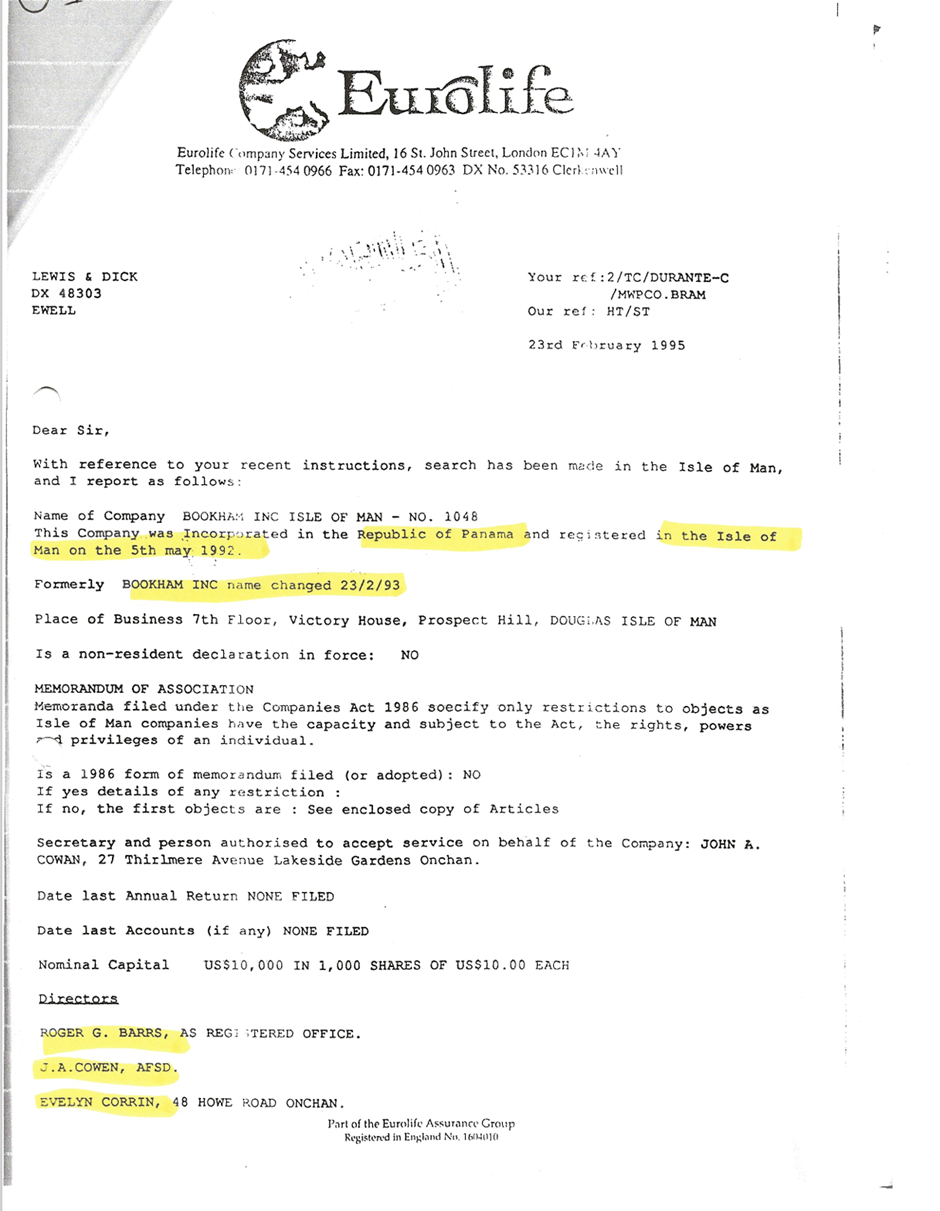
Richard Alan Costain issued numerous mortgages from Durante family companies without the family’s knowledge or consent. Against that background, the regulator’s claim that “the Durante trust was not affected” demonstrates a serious failure of basic due diligence.
There is no such legal entity as “the Durante Trust.” The correct trust is the Manor Trust, which is based in the Isle of Man. For the regulator to rely on a trust name that does not even exist underlines the superficial level of investigation that was carried out into Mr Costain’s activities and their direct impact on the family’s assets.


The legal review conducted by Lord Garnier into the Isle of Man forms a substantial part of Jordan’s work. It is clear from that review that Lord Garnier accepted that Mr Costain had stolen from the family companies and set out, in direct terms, why systemic problems exist within the Isle of Man’s legal and regulatory environment.
Lord Garnier further explained how a closed professional culture had developed on the island, in which lawyers and firms become commercially interdependent. As outlined in the review, all operate under shared professional indemnity insurance arrangements, creating a structural conflict of interest: the exposure of serious fraud would carry financial consequences not just for one firm, but for all connected parties within that network. This, in Jordan’s assessment, helps to explain why fraud is so often suppressed rather than properly exposed in the Isle of Man.

One deeply concerning fact that Jordan leaves with the public is this: the commissioner of oaths involved in the dissolution of the company Bookham was Paul Patrick O'Neil. Bookham was dissolved without the family’s knowledge or consent, and the family has never received accounts from Bookham to this day.
Shortly after this professional involvement, Mr O’Neil was arrested on serious criminal charges for child abuse. He later travelled to Scotland, where he died in circumstances that were formally treated as non-suspicious by the authorities. However, the unusual nature of the circumstances has continued to raise questions in the minds of those following the wider case.
Separately, Jordan has identified intersecting professional connections involving Robert Maxwell, George Stuart, and Richard Alan Costain, which appear across multiple trust and corporate structures. These links extend through Jersey and into the network surrounding the family’s trustee arrangements and company directorships.
Jordan states that further documented evidence relating to these overlapping relationships will be released in due course, including material he believes connects these structures to broader international financial misconduct and many murders.
Exclusive: Lawyer stabs himself then jumps to his death from Erskine Bridge after child abuse charges
A WELL-KNOWN lawyer accused of child sex crimes stabbed himself in the stomach before jumping to his death from a bridge.
Mark McGivern Chief Reporter
14:59, 01 Jul 2012 Updated 09:00, 02 Jul 2012
A WELL-KNOWN lawyer accused of child sex crimes stabbed himself in the stomach before jumping to his death from a bridge.
Father-of-two Paul O'Neill, 45, leapt from the Erskine Bridge near Glasgow two days after he appeared in court charged with two sex offences against a young girl.
A police insider revealed last night that a stab wound was found on O'Neill's body.
The source added: "It seems that, given his very high social status and his family background, he could not face the court proceedings that lay ahead of him."
O'Neill, a Scots advocate who practised on the Isle of Man, appeared at Hamilton Sheriff Court in Lanarkshire on Wednesday last week.
He made no plea to two charges of lewd, indecent and libidinous practices and behaviour and was bailed. The alleged offences dated back to 1994.
On Friday, O'Neill, who was originally from East Kilbride, was seen climbing a fence beside the Erskine Bridge.
A shocked driver saw him plunge to his death.
The Record's source said: "When his body was examined, he was bleeding from a wound in his stomach, believed to have been caused by a knife.
"There was also evidence that he had carried a rope to the scene.
"It is clear that the victim was in a disturbed state."
The Erskine Bridge has been a notorious suicide spot for years.
Thanks for reading
Kind regards
Jordan Durante


Comments